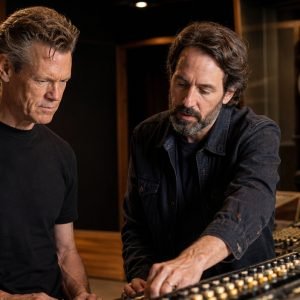
Tony Logue has returned with his latest full-length effort, Sixty Cycle Hum, a project that stands as a stark repudiation of the polished, commercialized tropes currently dominating the mainstream Nashville machine. In an era where country music often feels indistinguishable from pop, Logue doubles down on the bedrock of the genre: storytelling that prioritizes truth over performance. As noted by industry authority Saving Country Music, the album is a masterclass in authenticity, eschewing the trend of “country cosplay”—where artists adopt working-class aesthetics without the lived experience—in favor of a genuine, grit-filled portrait of American life.
Key Highlights
- Authentic Storytelling: Logue bypasses radio-friendly tropes to deliver narrative-driven songs that resonate with actual blue-collar experiences.
- Genre Integrity: The album is recognized for avoiding “cosplay” country, marking a return to the roots of honest, character-driven songwriting.
The Sonic Metaphor: The title, Sixty Cycle Hum*, serves as a direct reference to the electrical interference in guitar amplifiers, symbolizing the “ground noise” of life that persists beneath the surface.
- Critical Reception: Industry observers have highlighted the project as a critical counter-narrative to the highly processed, commercial output often found in current country charts.
Unearthing the Sound: Authenticity in an Age of Artifice
To understand the significance of Tony Logue’s Sixty Cycle Hum, one must first examine the current landscape of the Americana and country music genres. For the past decade, the industry has been embroiled in a tug-of-war between the polished, high-gloss production of “bro-country” and the defiant, often gritty resurgence of the independent scene. Logue, a Kentucky-based songwriter with a keen eye for detail, has positioned himself firmly within the latter camp. The album is not merely a collection of tracks; it is a declaration of intent.
The Anatomy of the “Sixty Cycle Hum”
The title itself is a stroke of brilliance for those familiar with the mechanics of electric instrumentation. A “sixty cycle hum” is the audible 60Hz electrical interference that manifests when a guitar amplifier is not properly grounded. It is the sound of the machine itself struggling to function in the real world. By choosing this title, Logue establishes the thematic framework of the entire record: this is music for those who are “plugged in” but perhaps imperfectly grounded. It captures the background stress, the low-frequency anxiety, and the constant, persistent noise of life that exists for the working class.
Logue’s songwriting on this record moves away from the party-centric anthems that saturate satellite radio and instead leans into the interiority of the blue-collar experience. He writes about the tangible—the bills, the labor, the strained relationships, and the quiet moments of reflection—without ever feeling the need to oversell his credentials. There is no “cosplay” here. There is no donning of a cowboy hat merely as a costume for the stage; the hat, in this context, is simply headwear for a man who lives the life he sings about.
The Kentucky Influence and Narrative Tradition
The geography of music matters. Kentucky has long served as a crucible for country and bluegrass, producing songwriters who prioritize lyrical density and emotional vulnerability. Logue fits squarely into this lineage, drawing comparisons to artists who view the pen as a tool for dissection rather than decoration. On Sixty Cycle Hum, he utilizes his environment—the landscape of the working-class South—not just as a backdrop, but as a character in the narrative.
By focusing on these specific, regional realities, Logue creates a sonic web that traps the listener in a specific time and place. The economic pressures that define the characters in his songs are not hyperbolic; they are the quiet, crushing reality of inflation, stagnant wages, and the pursuit of a stable existence. This economic realism provides the album with a weight that ephemeral pop-country simply cannot emulate.
Breaking the Fourth Wall of Genre
One of the most compelling aspects of Sixty Cycle Hum is how it interacts with the current “country-adjacent” market. As the lines between pop, rock, and country continue to blur, Logue stays true to the traditional sonic architecture. You hear the steel guitar, the acoustic rhythms, and the deliberate pacing of a man who understands that a story requires room to breathe. He refuses to cater to the “TikTok-ification” of music, where songs are written to be clipped into fifteen-second soundbites. Instead, he provides full-length, narrative-heavy compositions that demand the listener’s full attention.
This approach has earned him respect among traditionalists and critics who fear that the genre is losing its soul to corporate interests. By rejecting the “performative” aspect of modern country—the performative toughness, the performative patriotism, the performative rurality—Logue manages to sound more “country” than many of his peers who wear the label like a brand.
The Future of Independent Country
Looking forward, the success of records like Sixty Cycle Hum suggests a shift in how audiences consume country music. There is a burgeoning market for artists who offer substance over style. As the listener base becomes increasingly fatigued by the homogenized output of the Nashville major-label system, the trajectory for artists like Tony Logue is upward. They are building a sustainable model of success based on direct-to-fan engagement and authentic storytelling, rather than relying on the gatekeepers of radio.
Logue’s work provides a blueprint for this sustainable model: write truthfully, record honestly, and trust that there is an audience hungry for the resonance of real life. As the “hum” of his album continues to vibrate through the independent music scene, it serves as a reminder that the most powerful music is often that which is most willing to look at the cracks in the foundation rather than covering them up with paint.
FAQ: People Also Ask
Q: What is the primary theme of Tony Logue’s “Sixty Cycle Hum”?
A: The album is primarily centered on authentic, blue-collar storytelling, rejecting modern country tropes in favor of raw, lived-in narratives about the realities of working-class life.
Q: Why is the album titled “Sixty Cycle Hum”?
A: The title is a technical reference to the electrical interference (the hum) found in guitar amplifiers, which acts as a metaphor for the persistent, background noise and pressures of daily life.
Q: How does this album differ from mainstream country music?
A: Unlike many mainstream country albums that rely on “cosplay” or manufactured aesthetics, Logue’s record prioritizes genuine character study and avoids the over-produced, pop-influenced sound dominant in current radio hits.
Q: Who is the artist Tony Logue?
A: Tony Logue is a Kentucky-based musician known for his deep ties to the regional songwriting tradition, focusing on narrative-driven compositions that honor the history of the Americana and country genres.