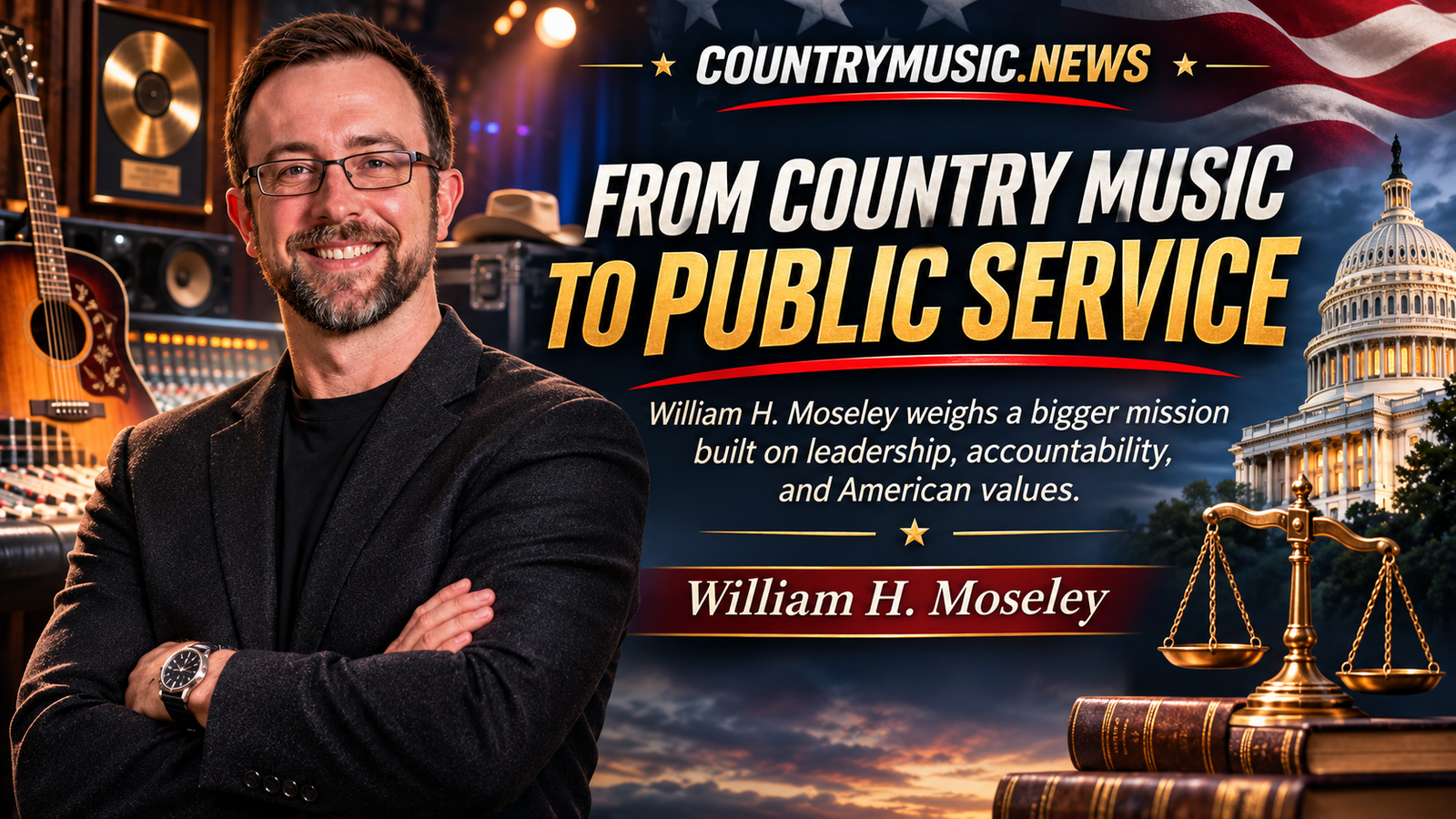
From developing recording artists and negotiating major music deals to confronting threats, alleged harassment, and government bureaucracy, the Grammy-nominated entertainment executive is contemplating a future beyond the music industry.
By CountryMusic.News | Industry & Leadership
William H. Moseley knows how to make a complicated deal happen. He has built a career negotiating contracts, developing recording artists, managing valuable music catalogs, and navigating an entertainment industry where reputations and livelihoods are constantly on the line.
Now, the multi-platinum music executive is weighing a decision that could fundamentally change his future.
After years of alleged harassment, attacks on his professional relationships, and an armed confrontation at his home, Moseley says he is prepared to step away from substantial entertainment opportunities and pursue something entirely different: public service and government accountability.
For someone whose business interests extend across country music, hip-hop, reggae, artist management, music publishing, and distribution, the decision carries considerable professional and financial consequences.
But Moseley believes the issues that brought him to this point extend far beyond his personal experience.
His argument is straightforward. Americans should not need considerable wealth, political connections, or years of personal effort to obtain meaningful attention when their safety, businesses, and constitutional rights are at stake.
And unlike the people he believes tried to force him out of business, Moseley says his professional success has given him the freedom to make his next move on his own terms.
Who Is William H. Moseley? Inside His Country Music and Entertainment Career
Moseley is a music executive, songwriter, producer, and entrepreneur whose career includes Grammy-nominated projects, multi-genre entertainment partnerships, and involvement with internationally recognized recording artists.
Through William Moseley Agency, Kingmaker Music, and Thug World Music Group, his work encompasses artist development, executive production, publishing, intellectual property administration, distribution strategy, and entertainment business management.
His experience includes working across different genres and building commercial relationships around artists whose audiences extend well beyond traditional industry categories.
In country music, Moseley’s business approach emphasizes artist independence, long-term ownership, strategic partnerships, and the development of valuable recording catalogs.
One example is his work with country recording artist Austin Tolliver, whose 2026 partnership with Kingmaker Music and The Moseley Group brought together artist management, branding, marketing, executive production, and distribution strategy.
The campaign included Tolliver’s single Black Sheep, released through EMPIRE, alongside a broader effort to expand his position in contemporary country music.
For Moseley, the underlying principle has remained consistent: artists should have the opportunity to develop lasting careers rather than surrender their futures for short-term financial rewards.
That requires negotiations, substantial investments, a willingness to take commercial risks, and an understanding that professional credibility must be earned.
He has applied those same principles throughout his work with recording artists and business partners.
It also explains why he says the attempts to undermine his professional relationships became particularly consequential.
While individuals he accuses of targeting him were allegedly attempting to damage his reputation, Moseley continued expanding his business interests.
New projects moved forward. Artists released music. Partnerships developed. His companies continued operating.
The contrast became central to his assessment of the situation: his detractors were focused on damaging his future while he was occupied with building it.
Seven Years of Alleged Threats and Business Interference
According to a detailed personal account published by All Access Insider, Moseley describes approximately seven years of threatening conduct, harassment, reputational attacks, and alleged interference with professional relationships.
He says individuals contacted people associated with his businesses, challenged his credibility, and attempted to influence commercial relationships.
The alleged conduct was particularly troubling to someone whose career depends on trust between artists, representatives, distributors, and entertainment companies.
A disputed business relationship can be addressed through contracts, negotiations, or litigation. Personal intimidation and threats introduce an entirely different problem.
Moseley says he repeatedly attempted to bring concerning conduct to the attention of appropriate authorities.
On November 8, 2023, according to his account, an FBI agent acknowledged in writing that a complaint involving threats had been documented and transferred internally.
Moseley says the complaint included public statements about repeatedly assaulting him with a baseball bat.
The acknowledgment established that his report had entered an official process. It did not, however, provide him with a clear understanding of what happened after the internal transfer.
He continued documenting incidents and preserving information.
Then, on September 3, 2025, the situation became considerably more serious.
The September 2025 Armed Confrontation That Changed Everything
At approximately 2:45 a.m. on September 3, 2025, Moseley says he approached his front door expecting a food delivery from DoorDash.
Instead, he encountered two unidentified individuals.
At least one, he says, possessed a weapon.
What followed was a physical confrontation that continued inside his home.
According to Moseley, he struggled for control of the weapon, ultimately disarmed the individual, and forced both people out of his residence. One of the intruders reportedly sustained a serious eye injury during the encounter.
He has described the incident as a moment when hesitation could have carried devastating consequences.
He did not know the individuals’ intentions, whether they planned a robbery or a more serious attack, or what might have happened had he failed to gain control.
The identities of the two individuals have not been established in his published account.
Nor has Moseley claimed to have conclusively established that anyone associated with the earlier harassment arranged or directed the confrontation.
That distinction remains important.
Although Moseley believes the broader pattern of conduct warrants close examination, determining who committed the alleged crimes and whether separate incidents were connected remains the responsibility of law enforcement.
Nevertheless, the confrontation changed how he approached his personal security and the pursuit of accountability.
The executive who had spent years negotiating commercial disputes was suddenly confronting circumstances in which the stakes extended well beyond contracts or money.
The EyeHatcher Communications and Disturbing Aftermath
Following the confrontation, Moseley says he began receiving disturbing communications from someone operating under the name EyeHatcher.
Among the messages he described was a directive encouraging him to take his own life, accompanied by language characterizing the communication as something other than a threat.
The name attracted his attention because one of the unidentified individuals involved in the September confrontation had reportedly suffered a significant eye injury.
Moseley also described messages suggesting surveillance, disturbing imagery, and an incident in which a stuffed animal smeared with ketchup appeared at his home.
He regarded the communications as potentially significant investigative leads.
However, the username, references, and timing do not independently establish who sent the messages or whether that person participated in the confrontation.
For Moseley, the episode reinforced an uncomfortable reality: documenting troubling conduct and obtaining meaningful official action are not necessarily the same thing.
He had already spent years reporting what he believed to be an escalating pattern.
After the events of September 2025, he decided to commit substantial personal resources to obtaining more concrete answers.
A Music Executive Who Used His Own Money to Pursue Answers
Successful entertainment executives routinely make high-stakes decisions involving money, risk, confidential information, and competing interests.
Moseley brought that experience to the effort to understand the conduct he says had affected his personal and professional life.
He hired professional assistance, examined records, preserved communications, and worked to identify people he believed were connected to the broader pattern of harassment and interference.
The undertaking required substantial financial resources that could otherwise have supported artist development, business expansion, recording projects, or his family’s future.
He says the work eventually produced names, communications, relationships, and documentary information that helped clarify incidents he had spent years trying to understand.
Moseley maintains that he has identified individuals he believes are connected to portions of the alleged harassment and interference.
That does not establish criminal liability, and he acknowledges that the identities of the two people who confronted him at his home remain unresolved.
He also recognizes that the authority to determine whether evidence supports criminal charges rests with the relevant investigative and prosecutorial institutions.
His position is that the evidence he has assembled deserves serious examination, not that a private citizen can independently determine criminal guilt.
The experience nevertheless produced a larger concern.
If someone with the financial means and professional relationships to pursue an extensive private review can still struggle to obtain institutional accountability, what happens to Americans without those advantages?
When Government Bureaucracy Becomes Part of the Problem
Moseley’s criticism is not limited to the conduct of private individuals.
He also questions how public institutions respond when citizens report threats or face accusations that may be used to disrupt their livelihoods.
According to his statement, federal agencies including the FBI, IRS, DEA, and TSA were referenced in communications or disputes that he interpreted as efforts to intimidate him or interfere with his business interests.
He also described an entertainment business disagreement involving questions about music authorization, distribution, and payment that escalated into warnings about incarceration and possible official consequences.
An Oregon Department of Justice complaint subsequently became part of the situation.
Moseley disputes the underlying accusations and characterizes the complaint as retaliatory. He says the matter ultimately closed after requiring significant time, documentation, and financial expense to address.
In one instance, he reports receiving only three business days to respond to supplemental allegations.
The disparity in institutional responsiveness left a lasting impression.
Government procedures could impose immediate obligations on him when he was the subject of a complaint, he argues, while his earlier reports involving threats and intimidation seemed to produce far less visible accountability.
He does not suggest that government agencies should abandon due process or disregard legitimate complaints.
His objection concerns the possibility that public resources and administrative procedures can become instruments of intimidation when allegations are made for improper purposes.
He believes government must be capable of distinguishing legitimate enforcement from attempts to manipulate the system.
For a business executive accustomed to making decisions, meeting deadlines, and taking responsibility for results, years of referrals and unresolved concerns represent a serious institutional problem.
Moseley’s criticism is directed at a culture in which process can become a substitute for performance.
He maintains that responsible public employees deserve respect, but leadership must ultimately be measured by outcomes, lawful conduct, and accountability to the citizens government exists to serve.
Defending Business Relationships While Respecting Constitutional Rights
Moseley has also pursued civil litigation concerning disputed publications, communications, and alleged interference affecting his professional relationships.
He has represented himself in those proceedings, bringing claims before the courts rather than attempting to resolve them outside established legal channels.
The litigation is separate from any potential criminal investigation. Its allegations remain subject to judicial determination.
The distinction matters to Moseley, who emphasizes his support for the First Amendment and the constitutional rights of people who disagree with him.
Freedom of speech, he believes, is a foundational American protection.
But the existence of that freedom does not automatically resolve questions about potentially unlawful threats, defamatory factual assertions, or improper interference with commercial relationships.
Those questions must be assessed under the applicable law, with evidence and due process.
Moseley says his objective is not personal retaliation.
It is the establishment of facts, the determination of legal responsibility where appropriate, and the protection of individuals and businesses from conduct that crosses lawful boundaries.
That philosophy connects his career in entertainment to his growing interest in public accountability.
Why William H. Moseley Is Considering Politics
Moseley has spent much of his professional life advocating for the interests of artists, business partners, clients, and the organizations he has helped build.
His recent experiences have led him to consider whether that responsibility should extend into public life.
He is now contemplating stepping away from substantial portions of his entertainment career to explore public service.
He has not identified a specific office or announced a formal campaign in the published statement.
Instead, he describes a broader change in priorities shaped by his concerns about government performance, personal liberty, economic opportunity, and the treatment of ordinary citizens.
His political outlook is deliberately independent of traditional party labels.
Moseley identifies with American principles that include faith, family, individual freedom, free enterprise, personal responsibility, and the rule of law.
He believes those principles should carry more weight than partisan competition.
The businessman who has negotiated deals between competing commercial interests sees value in practical problem-solving rather than political theater.
For him, effective leadership requires recognizing competing interests, protecting fundamental rights, using resources responsibly, and accepting accountability for the results.
Public service, in that view, is not a prize awarded to the politically connected.
It is an obligation to the people who finance public institutions through their work and taxes.
Hard Work, Opportunity, and the Americans Carrying the Country
Moseley’s concerns extend beyond law enforcement and public safety.
His larger economic outlook is rooted in the opportunities that allowed him to develop businesses and participate in the entertainment industry.
He believes honest work should create a path toward financial stability, homeownership, business ownership, and lasting economic independence.
That message reaches beyond country music audiences.
It speaks to the construction worker trying to buy a home, the veteran establishing a company, the independent musician financing a recording, the family operating a small business, and the parents working multiple jobs to provide a better future for their children.
Moseley argues that public institutions should support the ability of Americans to build meaningful futures without demanding extraordinary resources simply to protect their existing rights.
He has negotiated commercial agreements where decisions carry financial consequences and poor leadership can destroy value.
His expectation of government is different in its constitutional obligations, but not in its need for competence and responsibility.
The rights of ordinary Americans should never be treated as favors that depend on personal influence or access to powerful people.
For Moseley, that conviction is becoming central to his possible transition into politics.
What Would His Departure Mean for His Music Industry Career?
Moseley’s consideration of public service does not mean that his existing entertainment companies have failed or that he has exhausted his opportunities in music.
The opposite is central to his account.
His businesses have continued operating despite the conduct he believes was intended to derail them.
His professional portfolio includes valuable music rights, independent artists, and business relationships across multiple genres.
He remains positioned to develop additional recording projects, expand commercial partnerships, and continue building entertainment enterprises.
Choosing to devote significant time and resources to public life would therefore involve a genuine opportunity cost.
For country music, his potential departure from day-to-day entertainment work would represent a change for an executive whose approach emphasizes artist independence, strategic rights management, and the value of cross-genre partnerships.
Yet the same professional background may also influence his approach to public policy.
The music business has given Moseley direct experience with entrepreneurship, intellectual property, independent contractors, contractual obligations, risk management, and the economic pressures facing creative professionals.
Those are not theoretical matters to someone who has spent years working with artists and running businesses.
They are everyday decisions involving actual livelihoods.
What Comes Next for William H. Moseley?
The September 2025 confrontation remains part of an unresolved larger picture.
Moseley says the information gathered through his personal efforts has helped him identify individuals he believes were associated with portions of the alleged harassment and interference.
He continues to distinguish those findings from the unanswered questions surrounding the unidentified intruders and any potential involvement by additional parties.
Related legal proceedings and matters warranting law-enforcement attention must still be addressed through the appropriate institutions.
But Moseley does not intend to let those disputes determine the limits of his future.
He has built a career by pursuing opportunities others might have considered too complicated, defending commercial interests, and taking responsibility for decisions involving substantial financial stakes.
Now he is considering applying those abilities to a different set of challenges.
His central message is not that private citizens should replace law enforcement or take justice into their own hands.
It is that Americans deserve public institutions capable of fulfilling their responsibilities without forcing citizens to exhaust their savings and professional resources simply to be heard.
The people who allegedly sought to undermine his career did not prevent him from continuing to build it.
Instead, the experience appears to have changed what he wants to accomplish with the independence that career provided.
For a music executive accustomed to pursuing the next deal, the next release, and the next opportunity, the next chapter may have little to do with the recording business.
It may concern something much larger: an America where hard work creates opportunity, constitutional rights are respected, and government answers to the people.
And whatever direction he ultimately chooses, Moseley has made one principle unmistakable:
Public service is a responsibility, not a privilege.
This CountryMusic.News feature examines William H. Moseley’s publicly stated experiences, entertainment career, and consideration of public service. Accounts of disputed events, alleged misconduct, and investigative findings are attributed to Moseley and should not be understood as independent determinations of criminal liability. Read his original first-person statement at All Access Insider.