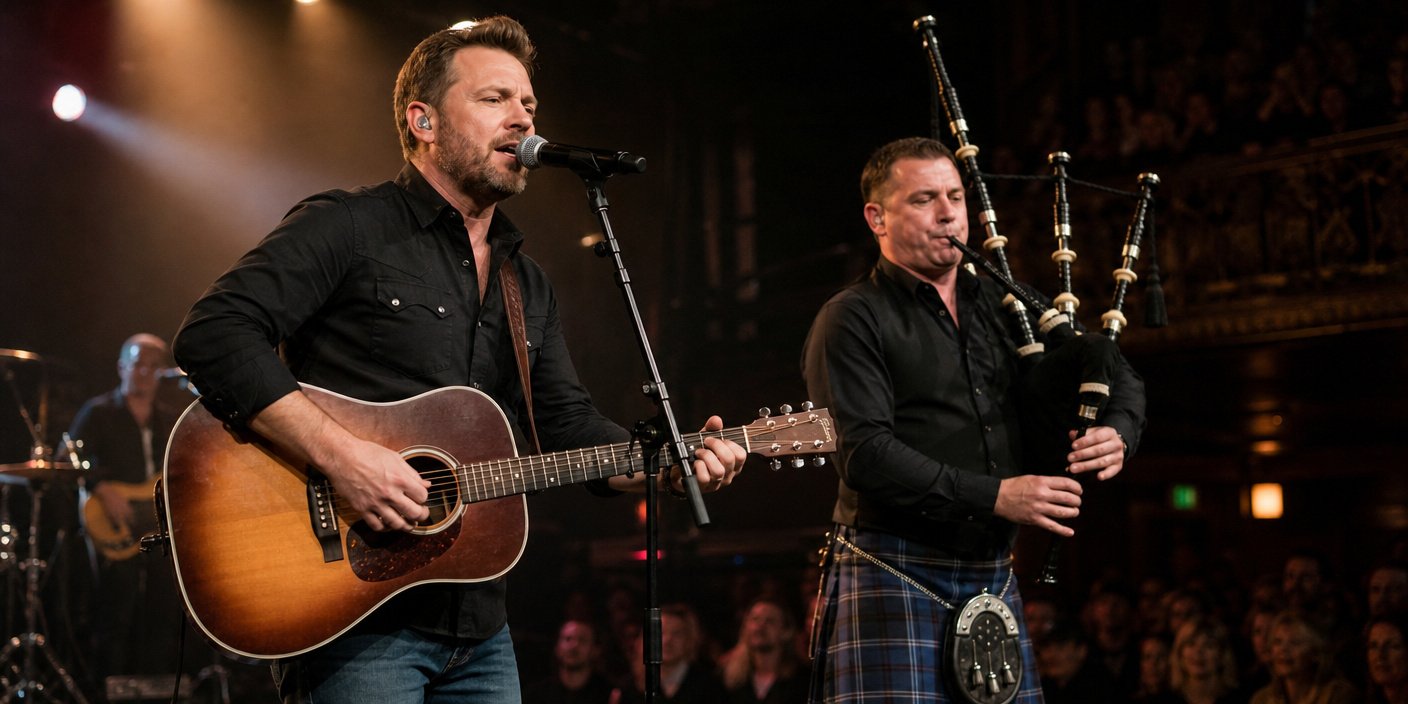
In a moment that blurred the geographical lines between the Australian Outback and the Scottish Highlands, country music sensation James Johnston captivated a packed Glasgow audience by integrating traditional bagpipes into his latest performance. The singer-songwriter, currently making waves across the United Kingdom, used the Scottish stage to unveil his new track, “COUNTRY SONG,” delivering a cross-genre performance that has since become a viral talking point for fans and critics alike. By subverting the traditional country sound with the sharp, resonant textures of Celtic instrumentation, Johnston has successfully signaled his ambition to transcend the limitations of the genre, transforming a standard tour stop into an unforgettable cultural exchange.
Key Highlights
- Glasgow Spotlight: James Johnston brought his UK tour to a climax in Glasgow, Scotland, featuring a unique, localized musical collaboration.
- “COUNTRY SONG” Debut: The performance served as a live showcase for his new track, “COUNTRY SONG,” which was recently released as a B-side to his popular hit “TAKES ME BACK.”
- Genre-Bending Performance: The collaboration with a local bagpiper fused Australian country aesthetics with traditional Scottish musical heritage, creating a distinctively atmospheric experience.
- Strategic Momentum: The stunt reinforces Johnston’s growing reputation for innovative live showmanship, capitalizing on the buzz surrounding his current UK tour dates.
Bridging the Transatlantic Gap: A Sonic Evolution
The performance in Glasgow was not merely a concert; it was a calculated display of artistry that underscores James Johnston’s evolving position in the international country music scene. For many Australian artists, breaking into the UK market requires more than just high-quality production—it requires a localized connection that respects the host culture while maintaining the performer’s identity. Johnston achieved this delicate balance by inviting a local bagpiper to accompany him during the performance of “COUNTRY SONG.”
The Mechanics of the Fusion
On a technical level, integrating bagpipes into a country arrangement is a precarious endeavor. The drone and piercing melodic capability of the Great Highland Bagpipe can easily overwhelm acoustic guitars and pedal steels. However, the arrangement utilized in Glasgow demonstrated a sophisticated understanding of sound engineering and live composition. The bagpipes were introduced during the song’s bridge, providing a cinematic expansion of the track’s melody rather than competing with the lyrics. This choice elevated the song’s emotional weight, transforming a standard live iteration into a “moment” that resonated deeply with the Glasgow crowd, who responded to the homage to their national instrument with significant fervor.
The B-Side Strategy: “TAKES ME BACK” vs. “COUNTRY SONG”
Johnston’s decision to pair “COUNTRY SONG” as a B-side to “TAKES ME BACK” highlights a specific, modern marketing strategy. In the streaming era, B-sides are often relegated to the background, but by actively promoting this track in a live setting, Johnston is signaling that “COUNTRY SONG” is not an afterthought—it is a narrative anchor. “TAKES ME BACK” carries the commercial weight of his established sound, while “COUNTRY SONG” provides the creative counterpoint. This “two-pronged” approach allows artists to satisfy radio-friendly expectations with the A-side while simultaneously proving artistic depth and versatility to their core fanbase. The Glasgow performance served as the ultimate testing ground for this strategy, proving that the live audience is willing to engage with new material if it is presented with the right level of showmanship.
Cultural Context and the Rise of Modern Australian Country
To understand why this Glasgow moment matters, one must look at the macro-environment of the music industry. The genre of country music is undergoing a massive global expansion, with Australian artists leading a significant charge. Historically, country music was anchored to the American South. Today, the “Nashville Sound” is being decentralized. Artists like James Johnston are proving that the storytelling core of country music is universal. By traveling to the UK—the ancestral home of many folk traditions that eventually influenced American country music—Johnston is participating in a cultural loop. The use of bagpipes was not just a stunt; it was a nod to the folk origins of the genre he occupies. This creates a compelling narrative of “full circle” musical evolution, which is precisely the kind of story that keeps artists in the news cycle long after the tour concludes.
Economic and Promotional Impact
From an industry standpoint, this performance serves as a masterclass in organic promotion. In an era where digital ads are increasingly easy to ignore, “viral moments” generated during live events possess a much higher conversion value. Fans attending the Glasgow show immediately flooded social media with clips of the bagpipe-infused performance. This created a secondary wave of content that reached fans who were not physically present. For an artist like Johnston, this effectively extends the tour’s reach beyond the venue walls. Furthermore, it differentiates him from other touring acts who play standardized, predictable sets. When a tour becomes an event rather than a routine, the economic value—measured in merchandise sales, streaming spikes, and future ticket demand—increases exponentially.
Future Outlook: What This Means for Johnston
As James Johnston moves forward with his career, the Glasgow performance will likely be cited as a turning point. It establishes him not just as a performer, but as an entertainer who understands the psychology of his audience. We expect to see more of this “localized innovation” in his future tour legs. Whether he is in Europe, North America, or back in Australia, the precedent has been set: James Johnston does not just play songs; he builds a dialogue with his host city. If he continues to leverage this strategy, he will likely cement himself as a mainstay in the global country circuit, capable of adapting his sound to any stage in the world.
FAQ: People Also Ask
1. Why did James Johnston choose to use bagpipes in his performance?
It was a creative choice to honor the host city, Glasgow, and create a unique, memorable moment that fused Australian country music with traditional Scottish instrumentation.
2. Is “COUNTRY SONG” a new single?
Yes, “COUNTRY SONG” is the latest track released by James Johnston, specifically positioned as the B-side to his song “TAKES ME BACK.”
3. Will this fusion be part of his future shows?
While specific setlists evolve, the positive reception of the Glasgow performance suggests that Johnston may continue to incorporate localized elements into his shows to build stronger connections with international audiences.
4. What is the significance of the release strategy for “TAKES ME BACK”?
By releasing “COUNTRY SONG” as a B-side, Johnston is using a traditional industry release model to introduce new, slightly more experimental material to his fanbase while relying on the popularity of his main single to drive listeners to the release.