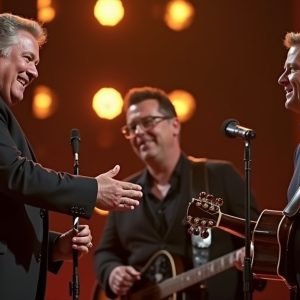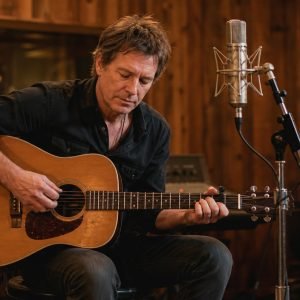
Benjamin Tod’s latest solo offering, “Country Is Dead,” is a jarring, necessary autopsy of a genre he argues has lost its soul to commercialism, delivered through raw steel guitar and uncompromising, plainspoken lyrics. Released under Anti-Corp, the album strips away the polished veneer of modern Nashville production to expose the fraying, desperate nerves of Americana music. By eschewing the stadium-ready anthems that currently dominate the charts, Tod cements his reputation as a modern-day outlaw, not by posturing, but by demanding a return to the visceral, storytelling tradition that once defined the heart of American roots music.
Key Highlights
- Return to Form: Tod doubles down on a stark, “plainspoken” lyrical style that prioritizes narrative honesty over melodic complexity.
- Production Choices: The album is defined by a sparse arrangement, relying heavily on emotive pedal steel guitar and piano to carry the heavy emotional weight.
- Industry Critique: The title “Country Is Dead” serves as a manifesto against the homogenization of Nashville, positioning the genre’s current state as a commercial shell of its former self.
- Authentic Loneliness: Across the tracklist, Tod explores themes of personal decay, institutional betrayal, and the specific isolation felt by the modern traditionalist.
The Autopsy of Modern Sound
Benjamin Tod has long been a polarizing and deeply respected figure in the underground Americana scene, primarily through his work with the Lost Dog Street Band. However, with “Country Is Dead,” he moves into a more intimate, solitary space. The album does not attempt to compete with mainstream output; rather, it functions as a direct refutation of it. The production is decidedly lo-fi and immediate, capturing the sound of a man speaking directly into a microphone in a room that feels far too quiet.
The Instrument of Truth
At the center of this sonic landscape is the pedal steel guitar. In many modern records, the steel guitar is used as a textural garnish—a way to “country up” a pop song. Here, it is the primary narrator. The instrumentation is agonizingly simple: usually just the steel guitar, a piano, and Tod’s voice. By stripping away drums and layered production, Tod forces the listener to confront the space between the notes. This is a “country” album in the most literal, pre-commercial sense, echoing the influences of early Hank Williams or the bleaker moments of Townes Van Zandt. The piano arrangements, in particular, provide a grounding rhythm that emphasizes the heavy, often melancholic nature of the lyrical content.
Lyrical Integrity and the ‘Plainspoken’ Approach
The lyrical style on “Country Is Dead” is, as critics have noted, “blunt and plainspoken.” Tod avoids the ornate metaphors that clutter much of modern folk-country. Instead, he deals in blunt truths—addiction, the failure of the American dream, and the realization that the art form one loves is no longer “theirs.” This isn’t just an album about the death of a genre; it is an album about the death of the context in which that genre thrived. When Tod sings about being a “traditionalist,” he is mourning the loss of the working-class storytelling that once anchored the genre.
Economic and Historical Contexts
To understand the gravity of “Country Is Dead,” one must analyze the broader economic and historical forces at play.
1. The Commercialization Trap: The modern Nashville industry operates on a high-velocity cycle of song-writing camps and cross-genre hybridization. Tod’s project acts as an antithesis to this, representing a “boutique” approach to music-making where the value is derived from the artist’s personal narrative rather than the catchiness of a chorus. This creates a sustainable, albeit niche, economic model for the independent artist who rejects label-imposed sonic trends.
2. The Outlaw Legacy: Historically, every generation of country music has an “outlaw” faction—the Willies, the Waylons, and the Merle Haggards—who rebelled against the establishment. Tod is arguably the spiritual successor to this lineage, though his rebellion is less about “partying” and more about “integrity.”
3. Future Predictions: As digital streaming creates larger gaps between the top 1% of mainstream artists and the rest, we are likely to see more artists like Tod retreating into these hyper-traditional, stripped-back soundscapes. It is a defense mechanism against an industry that rewards conformity.
FAQ: People Also Ask
Q: What is the main theme of Benjamin Tod’s album “Country Is Dead”?
A: The album focuses on the loss of authentic, traditional values within the country music industry and the personal struggles of remaining a true traditionalist in an increasingly commercialized landscape.
Q: What instruments are featured prominently on the album?
A: The album is largely defined by its sparse arrangement, focusing heavily on the pedal steel guitar and piano, with very little in the way of percussion or modern production polish.
Q: Is Benjamin Tod quitting music?
A: No. The title is a critique of the genre, not a retirement announcement. It serves as a statement on the state of the industry rather than a reflection of his own creative future.